Description
Aster novi-belgii ‘Starlight’ (Symphyotrichum novi-belgii ‘Starlight’)
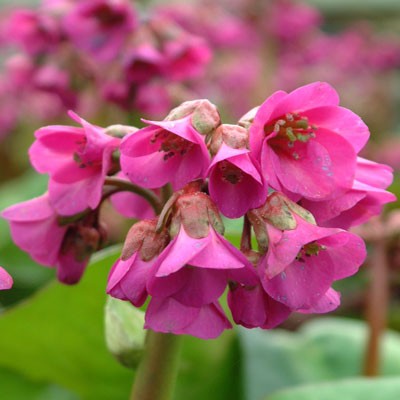
I’ve always thought that Starlight was a rubbish name for this lovely little Aster – it just doesn’t seem to fit, but despite this it’s a little beauty. Aster novi-belgii ‘Starlight’ (Symphyotrichum novi-belgii ‘Starlight’) is relatively short and compact at 40cm and the flowers are a generous size in a strong glowing pink. Each individual semi-double bloom has a full skirt of neatly arranged narrow petal that are a strong mid-pink, darkening slightly towards a centre that is a mix of ruby red and yellow.
Michaelmas Daisies
There are Aster species from across the Northern Hemisphere, but the majority come from the Northern United states and Canada. They are reliable stalwarts of the late summer garden, helping to finish off the summer and lead us into autumn with a final hit of colour. Few could deny that Aster ‘Alma Potschke’ delivers one of the most eye-wateringly pink experiences of the floral year. Michaelmas is the third of the quarter days; 29th September.
The first Aster to enter Britain came in 1633 with John Tradescant the younger. He brought back Aster tradescantii from his travels in Virginia.
The breeding of Aster novi-belgii began with a Midlands brewer, Ernest Ballard. He noticed a seedling in his Malvern garden that he thought very fine. Subsequently, he submitted it to the RHS for assessment only to be ignored twice. Finally, after persisting, and in the third year of trying Aster ‘Beauty of Colwall’ was awarded a First Class Certificate. The Ballard family have since bred and named many fine cultivars .
Aster ‘Harringtons Pink’ was the first A.novae-angliae hybrid to arrive in Britain, sent by the Americam who raised it. It is a variety that we still sell today.
Another important group is the earlier flowering Aster Amellus cultivars and the related Aster x frikartii. They flower in the second half of the summer on shorter, more open plants. They are an absolute magnet for butterflies and long lasting colour in the border. This is a European and Asian group of plants. Aster amellus is a fine species in its own right, but a Swiss breeder called Monsieur Frikart crossed it with Aster thomsonii and created the finer Aster x fikartii, of which ‘Monch’ is a splendid example.
Naming
Recently the Botanists have been about Aster with a vengeance and you will now find several of the Asters reclassified under the rather attractive names of Eurybia and Symphyotrichum. I think there should be a prize for anyone attempting to fit Symphyotrichum novae-angliae ‘Andenken an Alma Potschke’ on one 4” pot label. I’ve listed these nomad species under both their new names – for correctness, and also the old ones – for nostalgia and those who don’t like change. Botanists have actually distributed Aster amongst 6 different genera; Aster, Doellingeria, Eurybia, Ionactis, Oclemena, and Symphyotrichum. These are not new names, but re-adoptions of names coined at points during the 19th century to split the Genus Aster, often on geographic grounds.
The Greeks first used the Generic name Aster, It means Star.
Links –