Description
Caltha polypetala
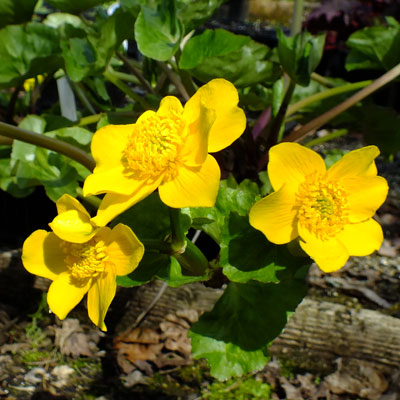
Giant Marsh Marigold. This is a larger form of our native Marsh Marigold, bigger in all its parts and growing up to 2ft across. It has the same shiny leathery foliage and branching stems of shining golden yellow buttercups. which usually carry extra petals – 7 or so rather than the usual 5ish. Suitable for any permanently wet site, including with its feet in water. Will root at the nodes of the flower stem. The Marsh Marigold is a very variable species with several varietal divisions proposed in different sources. I have tried to name this correctly, but I find this plant listed under a number of different subdivisions of Caltha palustris – var. major, var. polypetala and var. palustris – as well as a species alone, so I have listed them all as synonyms and followed the catalogue of life’s accepted name . Marsh Marigolds are amongst the first flowers of Spring, flowering throughout the month of April.
Caltha
You can often tell the importance a plant has played in the lives of people by the number of common names it goes by. The common Viola would be a good example, try this one out for size as well. Caltha, whilst most commonly Marsh Marigold or Kingcups, it is variously known as brave bassinets, crazy Beth, horse blob, May blob, mare blob, boots, water boots, meadow-bright, bullflower, meadow buttercup, water buttercup, soldier’s buttons, meadow cowslip, water cowslip, publican’s cloak, crowfoot, water dragon, drunkards, water goggles, meadow gowan, water gowan, yellow gowan, goldes, golds, goldings, gools, cow lily, marybuds, meadow routs, leopard’s foot, verrucaria, solsequia, sponsa solis and publicans-and-sinners. The most common of these, Marigold is a reference to its use to decorate the Church during the Middle Ages, being dedicated to of the Virgin Mary. It was also used in garlands and strewn before cottage doors for May Day.
Whilst we are on names, Caltha derives from the Greek for a chalice, and palustris a reference to its habit of growing in the margins on ponds. It could very nearly have been called Pupulago, a name used by Joseph Pitton in 1700 (although he also uses the name Caltha). The only reason that the rule of precedence, whereby the first published name must be used is that the rule only applies from 1st May 1753.
The common name verrucaria refers to its use for curing warts. Solsequia solis derives from it opening and closing with the sun. All parts of the plant are strongly irritant, though the buds have in past times been used as a substitute for capers, along with the leaves being boiled like spinach. The juice from the petals, boiled with alum (potassium aluminium sulphate) can be used to die paper yellow, though the effect is not permanent.




Reviews
There are no reviews yet.