Description
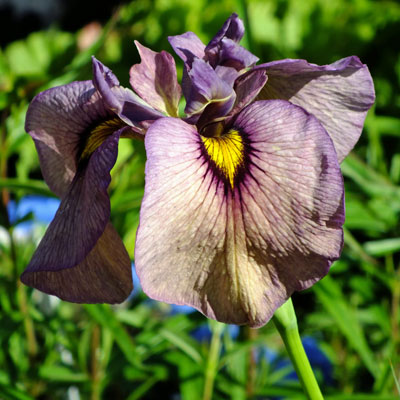
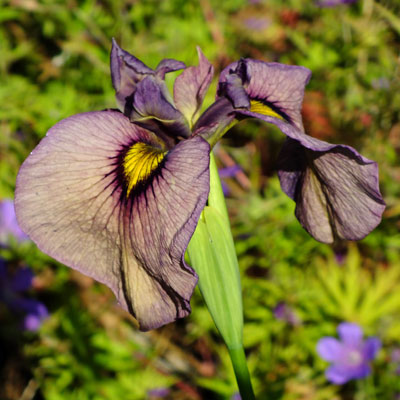
Iris ‘Yasha’
This is a rather dramatic variety that lives up to its name. The colouring changes markedly as each flower ages giving a multitonal effect to the clump. The flowers emerge largely mid purple but as they age the petals become creamy, flushed with lavender. The signal is a starkly contrasting yellow, boldly edged with wine red eyelash staining. Hiroshi Shimizu 2010. tall at 120cm. Yasha translates as ‘The Female Devil’ a creature from Japanes folklore adopted into Budhhist mythology. Honorable Mention 2014, Award of Merit 2017
Iris
“What we like about Iris sibirica apart from its slender grace and lovely blues and whites…is its willingness to do anywhere and to continue doing for years without asking for division.” – A.T. Johnson
The Genus iris is large, containing some 200 plus species. They cover a huge range of forms and habitats, which I won’t go into here. As we are largely only concerned with iris of two related sections, the Siberian Irises and the Sinosiberian Irises.
Sinosiberian
The section designated SinoSiberian Irises contains the species, Iris chrysographes and Iris pseudacorus, the Yellow flag. The name Yellow flag comes from the fluttering of the yellow fall. Many of its numerous other names come from corruptions of the Anglo-Saxon word for a sword, alluding to the leaves, though the unusual ‘Cheiper’ comes from the noise made by Children blowing the leaves between their thumbs like a reed.
The yellow flag grows equally successfully in the open garden or in very wet sites, wetter than conditions in which Iris sibirica would be happy. The green leafed form can be too vigorous for all but naturalistic plantings, but, in contrast, the variegated form behaves itself quite well.
History
Iris pseudacorus is the Fleur-de-Lis of France. Louis VII chose the flower as his emblem when he joined the Crusaders’ fight against the Saracens. Fleur-de-Louis gradually became corrupted through Fleur-de-Luce to Fleur-de-Lis. Lys is a river in Flanders, on whose banks Iris pseudacorus grows in profusion. Earlier than this, the Iris was taken by King Clovis as his heraldic symbol, replacing the three toads he previously used. Facing defeat, King Clovis was persuaded to pray to the Christian God of his wife Clothilde. When he achieved victory he converted to Christianity and made the change of symbol, Iris being the symbol of the Virgin Mary.
Common names
Iris pseudacorus. I. aquatic, I. lutia, Yellow Flag, Fleur de Luce, Dragon Flower, Myrtle Flower, Fliggers, Flaggon, Segg, Sheggs, Cheiper, Cucumbers, Daggers, Jacob’s Sword, Galdyne, Meklin, Levers, Livers, Shalder
Iris was the Roman Goddess of the Rainbow and messenger of the gods.
Links


Reviews
There are no reviews yet.