Description
Ligularia ‘The Rocket’
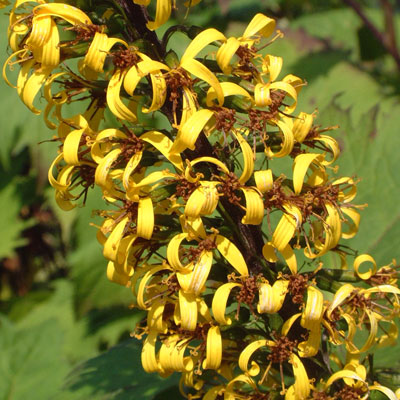
Ligularia ‘The Rocket’ is a big bold perennial to make a statement. The foliage is shield-shaped with an irregular saw-tooth edge, reaching at least a foot across. The flower spikes rise up to 2m, a shaggy spike of ragged bright yellow flowers all with dark contrasting stems. Needs a good moist to wet soil and a site away from the hottest rays of the sun. Long lived and easy if well sited.
Composite Flowers
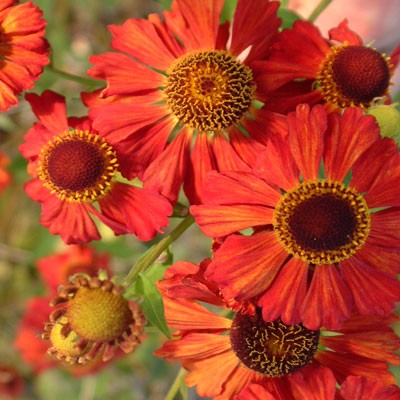
The composite flower head is the defining character of the Asteraceae. What appears to be a single daisy flower is in fact a flower head comprising of many many individual smaller flowers, in many cases two different forms of flower that together form the distinctive daisy structure. They make excellent flowers for insects to visit as each individual head is actually a multitude of nectar bearing flowers that the insect can collect from one after another.
There is a wealth of detail to study in the morphology of daisies along with a dictionary of names for the parts. I shan’t go into any great depth, but a little more detail might be interesting. The central part of the flower is called the disc and is comprised of a tightly packed array of more or less symmetrical flowers with quite small petals. These open from the outside inwards, with the outside being the oldest. Interestingly, if you study the arrangement of these flowers they are arranged in a series of spirals from the centre. You will be able to detect right and left handed spirals and if you take the time to count these spirals you will find that the number of left and right handed spirals will be two adjacent numbers from the Fibonacci series (This is a sequence of numbers made by by adding up the preceding two numbers in the sequence; Hence 1,1,2,3,5,8,13,21,34….)
The showy outer petals of a daisy are flowers of a different type. These are the asymmetrical ray florets. They lack the nectar of the disc florets and have the function of attracting insects (and gardeners!).
There is a third type of flower, a ligule, which is a asymmetrical flower with one elongate petal, that can occur in the disc region. These can give flower heads a shaggy appearance and can be seen in plants such as Ligularia or Eupatorium.
Some of the daisy family have flowers that track the sun, a mechanism designed to make the flower a warmer more inviting environment for pollinators, especially in cold but sunny weather. The consummate example of this is the Sunflower, Helianthus, which gets in name from its tracking of the sun rather than from its sun-like appearance.