Description
Stokesia laevis ‘Purple Parasols’
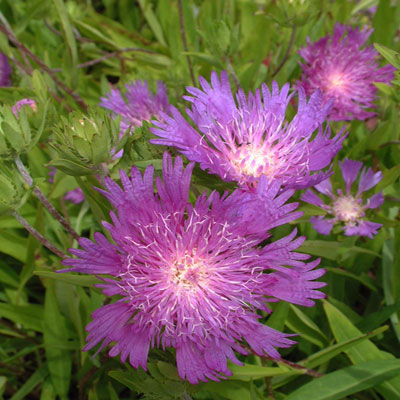
Stoke’s Aster. Stokesia laevis ‘Purple Parasols’ has large deep violet purple cornflowers from August to September and evergreen leaves make this an attractive and unusual perennial for a warm well drained spot. This variety tends to produce a really good number of well branched, fairly upright flowering stems. Good cut flower. 60cm
Stokesia (Stoke’s Aster) is a montypic Genus from the SE United States.
Stokesia thrives in a sunny spot in well-drained soil where it makes a useful front of border plant. The large flowers are notable for having ragged outer petals and a centre that is the same colour as the rest of the flower. Each flower is cradled in a ring of green bracts.
Composite Flowers
The composite flower head is the defining character of the Asteraceae. What appears to be a single daisy flower is in fact a flower head comprising of many many individual smaller flowers, in many cases two different forms of flower that together form the distinctive daisy structure. They make excellent flowers for insects to visit as each individual head is actually a multitude of nectar bearing flowers that the insect can collect from one after another.
There is a wealth of detail to study in the morphology of daisies along with a dictionary of names for the parts. I shan’t go into any great depth, but a little more detail might be interesting. The central part of the flower is called the disc and is comprised of a tightly packed array of more or less symmetrical flowers with quite small petals. These open from the outside inwards, with the outside being the oldest. Interestingly, if you study the arrangement of these flowers they are arranged in a series of spirals from the centre. You will be able to detect right and left handed spirals and if you take the time to count these spirals you will find that the number of left and right handed spirals will be two adjacent numbers from the Fibonacci series (This is a sequence of numbers made by by adding up the preceding two numbers in the sequence; Hence 1,1,2,3,5,8,13,21,34….)
The showy outer petals of a daisy are flowers of a different type. These are the assymmetrical ray florets. They lack the nectar of the disc florets and have the function of attracting insects (and gardeners!).




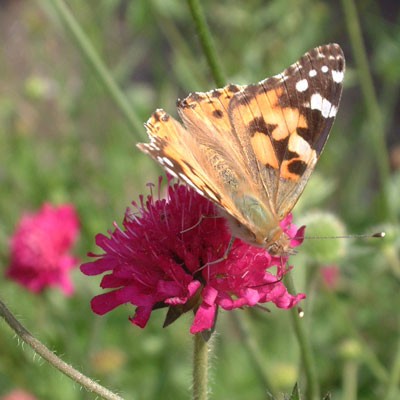
 Butterfly Friendly[/caption]