Description
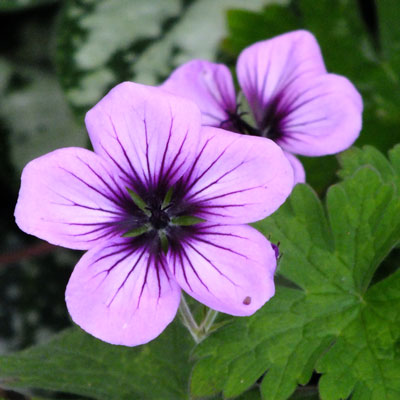
Geranium ‘Storm Chaser’
G.traversii x G.procurrens x G.lambertii. Another treasure from Alan Bremner, bred from a bevvy of dark-eyed Himalayan trailers. Gorgeous 35mm soft lilac flowers with a a dramatic dark magenta-purple, almost black eye which radiates through the petals in a network of purple veins. Flowering from June until August with a later flush in Autumn. Soft, slightly greyish foliage in a small 30cm high mound, 50cm wide. Best in sun or part shade and decent drainage. Good ground cover.
The genus Geranium is very large, containing at least 420 separate species so it’s no wonder there are so many garden worthy plants to choose from. If we were to generalise, they are on the whole tough, long lived and largely die down to the ground in winter. They fall largely in the range 20-60cm tall and are generally spreading clump formers producing a mound of basal leaves. However, some species, such as Geranium tuberosum produce a forest of stems with no basal leaves and others such as Geranium ‘Ann Folkard’ produce fewer long trailing stems. They are stalwarts of the summer garden, making low mounds at the front of the border, creating carpeting weed suppressing mats or scrambling up through roses or low shrubs. Their long flowering and subtle colours are valuable in so many ways.
Geraniums are suitable for a wide range of different growing conditions, tolerating all but the wettest of soils. Whilst there are Geraniums that are best suited specifically to sun and shade, most will tolerate sun or part shade. Geranium sylvaticum, Geranium nodosum, Geranium phaeum and Geranium macrorrhizum are particularly suited to growing in shady spots.
There is often confusion about which plants the name Geranium refers to, whether it is the cranesbills (Genus Geranium) or the Geraniums (Genus Pelargonium). The confusion arose in the 18th century when they were first being introduced to this country, when both Genera were included in the Genus Geranium. It was soon realised that they needed splitting and the Genus Pelargonium was created. However, as Pelargoniums were at the time the more popular plant, it is to these that the common name ‘geranium ‘ stuck. The confusion has persisted ever since. The Genus ‘geranium’ is now refered to as ‘the cranesbills’, a reference to the long explosive dispersal mechanism (rostrum) attached to the seeds, or the ‘hardy geraniums’.



Reviews
There are no reviews yet.