Description
Mecanopsis napaulensis
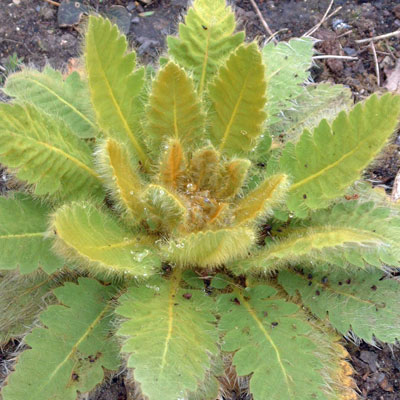
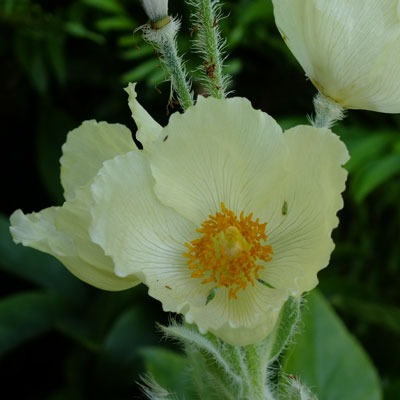
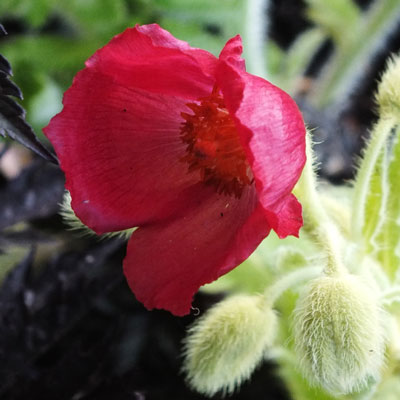
Who needs flowers when you have leaves like these ? Very handsome rosettes of leaves made golden by a rich gilding of yellow hairs. Although this species is almost always monocarpic, (dying after flowering), the faulous golden mounds sometimes take 3-4 years to produce flowers and in that time can give at least as much pleasure as the perennial forms, especially when the sun lights up the glittering hairs. Eventually a tall, 4 foot, spike adorned with a pyramid of many papery red blossoms. This plant requires a cool Summer position with adequate humus to keep the soil moist.
Whilst Mecanopsis napaulensis is a true wild species, the forms found in most gardens are far more likely to be part of a garden hybrid swarm with elements of Mecanopsis napaulensis, paniculata, stainoni and regia in their makup.
Mecanopsis are lovely, no doubt. However, the other thing that is beyond doubt is that they are not easy. Apart from the welsh poppy, Mecanopsis cambrica, and an American species, they are largely from high mountainous regions of the Himalayas which receives climatic conditions that are not easy to mimic here in Britain.
The usual advice is that they are plants for moist acid woodland. This is sound advice, but a little thought might lead you to find a better spot. In their natural habitat they experience a lot of sun, growing in fully exposed positions in well drained soils. However they grow with good subsurface moisture and at high elevations where the atmosphere is cool and the air dry. The woodland position is an attempt to control temperature, but can be too humid. You could also try a bright shade with a humus rich non-alkaline soil. It’s one of those plants – you’ll either get it right and it will love you, or get it wrong and wonder what should have been growing next to that label. ( Or alternatively be like my parents – have it in position where it was growing well… until my father cut it off with a hoe! )
The final piece of advice, and one that may be hard to take, is that it is best to remove the flowering spike from the blue mecanopsis in their first year. This will allow them to build up a stronger base from which to flower in subsequent years. Not doing so will increase the possibility of the plant putting too much of its resources into flowering and declining into an early grave. However, please don’t do this with Mecanopsis paniculata. This species is monocarpic and designed to die after flowering – all that you will achieve is no flowers!

Reviews
There are no reviews yet.