Description
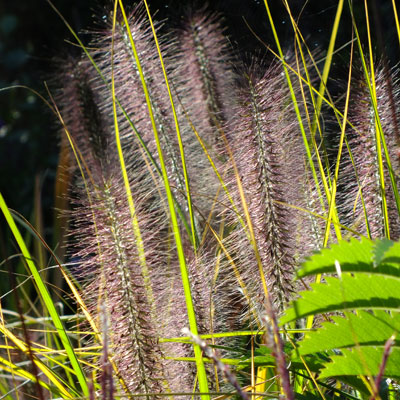
Pennisetum alopecuroides ‘Moudry’
Black Fountain Grass. Aptly named as the overall foliage shape is an arching mound from which erupt a mass of fluffy flower heads like arching jets of water. Each flower head begins a purple-black squirrel tail, ageing silver as they mature. The leaves turn golden yellow in Autumn, gradually fading straw-like for the remainder of Winter. 90cm in flower. They tolerate a wide range of soil types, tolerating drought well once fully established, but really resent excessive Winter wet. Full sun is best. The species originates in Australia and SE Asia and consequently plants tend to be slow to emerge in Spring, but once in growth the make up quickly. It is better not to cut them back too early as the foliage acts to insulate the crown. The flowers cut very well.
All grasses fall into one of two categories, the cool season grasses and the warm season grasses. This refers to the time at which they are in active growth and is a reflection of their underlying biology. It makes a difference to the gardener in that it points to the time of year when it best to propagate and plant your grass. It is most relevant to the warm season grasses which are in active growth only from later in Spring through Summer and particularly resent being split outside of their active growing season. Warm season grasses include Hakonechloa, Imperata, Miscanthus, Panicum and Pennisetum. Cool season grasses include Calamagrostis, Carex, Deschampsia, Festuca, Hordeum and Molinia.
The Cool season grasses are more correctly the C3 grasses, reflecting the fact that they fix carbon from the atmosphere into an initial 3 carbon molecule. This is the metabolic pathway that was earliest to develop and is used by most plants. It uses light to combine Carbon Dioxide and Water with ribulose bisphosphate (a 5 carbon compound) to form 2 molecules of 3-phosphoglycerate, a 3 carbon molecule. It works best under cooler condition but has the disadvantage that the enzyme that moderates the reaction also wastefully combines some Oxygen instead of Carbon Dioxide.
In a later development, the C4 pathway evolved in grasses in warmer climates. They still posses the C3 pathway but also use a method of combining ribulose bisphosphate into a 4 carbon product. This, however requires higher concentrations of Carbon Dioxide which the plants achieve by concentrating it in specialised structures called Krantz Anatomy. This process can fix more carbon from the atmosphere but requires additional energy to concentrate the Carbon Dioxide. Hence it is only possible in warmer conditions.
For those interested, these pathways are 2 of only 3 pathways used to fix carbon from the atmosphere into biomass and hence the turn the Sun’s energy into the overwhelming majority of food on Earth. (There is a minor amount of biomass created through chemical degradation of sulphur compounds around deep sea vents). The 3rd method of Carbon fixing is CAM or Crassulaceous Acid Metabolism which is described under the entry on Sedums. It is method that allows Carbon trapping under much drier conditions.






Reviews
There are no reviews yet.