Description
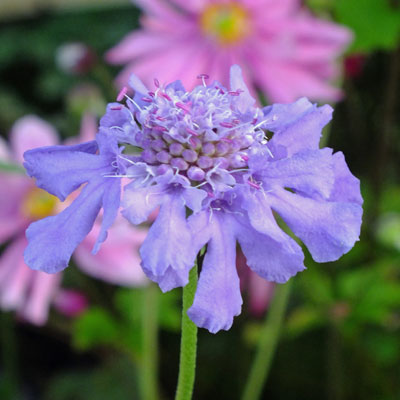
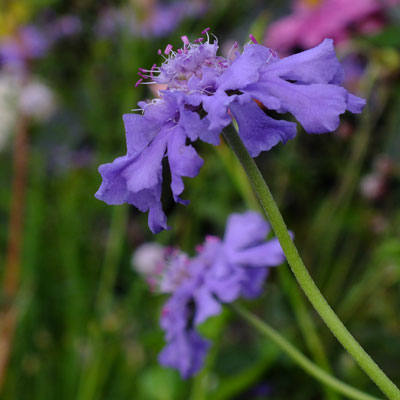
Scabiosa lachnophylla ‘Blue Horizon’
The flowering stems of Salvia lachnophylla ‘Blue Horizon’ rise tall and branched from a nest of pinnatifid foliage to dance off with numerous deep mauve scabious flowers. The purple pin-cushioned centres set off the deep pink stamens. The ray florets are quite large and their dissected nature and way in which they are held gives off a cottagey and charmingly disheveled air. Native of East Siberia, China and Japan, the wild form of Scabious lacnophylla grows in sandy, sunny sites. Blue Horizon has been selected for its neat bushy habit (24″). Providing it has good drainage, it is relatively more perennial than some other scabious, which can be short lived. Butterfly and bee magnet from July until the first frosts.
The most famous of the Scabiosa caucasica hyrids, Scabiosa ‘Scabiosa Clives Greaves’ has an amusing history.
Isaac House and Sons bred scabious in their Bristol Nursery, developing their famous House’s Hybrids amongst many other cultivars. they were always on the hunt of a strong growing, strong coloured lavender-blue. They were a clean living, deeply religious Puritan family. Clive Greaves was an overconfident, salesman from a Nursery in Solihull. He enjoyed a full life, sampling freely life’s pleasures. On one visit to the House’s nursery he boasted that he could sell quantities of any scabious given his name. To humour him, the Houses named a seedling after him – they picked what they thought an unremarkable one; it was thought ordinary, but had been kept because its flower shape was good and might parent something of use. Scabiosa ‘Clive Greaves’ was named and subsequently went on to out-perform and out sell anything the family produced thereafter. What these Puritans thought of the plant they named after a boastful salesman with a weakness for women and wine is not recorded.
Flower structure in Scabious:
I thought I would write a small piece on the intricate flower structure that scabious exhibit with the tight pincushion centre and flamboyant outer petals. Each individual flower head is in fact a compound flower just like the daisies, being composed of a tight dome of individual florets. The flowers making up the central disc florets and those more showy outer ray florets are essentially the same, all are basically trumpet like tubes, its just that the outer ones develop more colour and have much more flamboyant petals. It’s a case of scaling rather than form. Within the disc, the male stamens are held close to the flowers throat whilst the female pistil projects well out giving the flower its pincushion form. The often contrasting colours of each flower type and the colours of the stamens and pistil are what make theses flowers so attractive.
If you look closely at the unopened flower you can see that the individual florets are arranged in two spirals, one to the right and one to the left. It is a characteristic that shows up better in some species than others. What is fascinating about these spirals is that the number of spirals each direction will be different and they will be found to be two adjacent numbers on the Fibonacci sequence. (ie 1,1,2,3,5,8,13,21,34 a sequence made up by adding the previous number each time). This is an adaptation that allows the most flowers to fit in a given space with the least gap. Its not the only place you can find the Fibonacci sequence in plants. Plants always have the same number of petals in their flowers and the numbers plants use are to be found on the Fibonacci sequence – Plants really can count.





Reviews
There are no reviews yet.