


Potsize – 1L
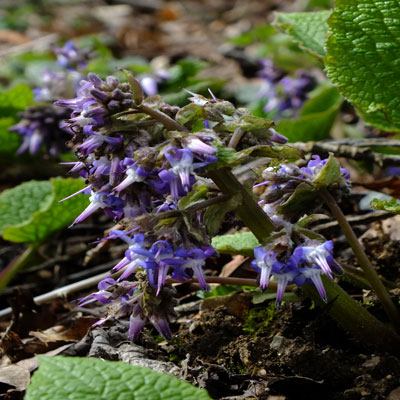
Trachystemon orientalis. An interesting and sometimes useful plant that can be great in the right place – excellent for the wild garden, just don’t plant it in the rockery. The leaves are large and coarse, reminiscent of comfrey and the flowers, which appear before the leaves in very early Spring, are like compressed spikes of borage. The flowers are curious in that the petals are rolled as if they’ve been in curlers and then when they are finished they leave behind the purple stamens stuck out like an electric shock. It runs with gusto and hence is good for covering ground against all-comers in unpromising places. The flowers, being early, are good for insects. There are records of it having naturalised in England going back to 1868.
The common name for this plant is the rather curious ‘Abraham-Isaac-Jacob’, the three founding fathers of Judaism, but I can’t really find out definitively why. I have had the following suggestion from the Office of the Chief Rabbi, but I find it doesn’t quite fit as Trachystemon shows little significant colour change as it ages.
“I believe the connection is simply that by being able to see a cluster with three differently coloured flowers, side by side, one might have said, “Look, there’s Abraham, Isaac and Jacob”, or in other words, three generations side by side, the older flower possibly looking a little less fresh than the younger.”
After much google-ing with friends, I think we might suggest a modification to this explanation: Common names attach to plants by common usage rather than scientific rigour. In the past several of the Boraginaceae have been known by the common name Abraham-Isaac-Jacob on account of the colour change in the flowers as they age. Although not the best example, Trachystemon became grouped under this umbrella name. As time passed, common usage favoured other names for most of these the plants leaving Trachystemon as the last plant for which Abraham-Isaac-Jacob still used.
In French it is Borage of the Caucasus (Bourrache de Caucase), echoing the other English name, Oriental Borage. They also use Consoude de Turquie much like the Italian: Borragine del Caucaso. In Germany it is Rauling
The flower, stems and young leaves can all be cooked and eaten. They are eaten in Turkey under the name aci hodan
Reviews
There are no reviews yet.